Ever put up a banner on a Friday and found it ripped off the fence by Monday?
If you run a business anywhere near the coast, or on a site that gets hit by strong gusts, you already know the problem. A regular banner just can’t take it. That’s where outdoor mesh banners come in, and honestly, most people don’t pick the right one until after they’ve lost a few banners to the wind.
Let’s fix that.
Why Wind Destroys Normal Banners
Here’s the thing. A solid vinyl banner acts like a sail.
Wind hits the flat surface and has nowhere to go. So it pushes. And pushes. Until something gives, usually the eyelets or the frame holding it up.
Once you’re above 30 to 40 km/h of steady wind, a solid banner on a long fence line starts to bow and strain. Add a gust on top of that, and you’re looking at torn edges or a banner flat on the ground.
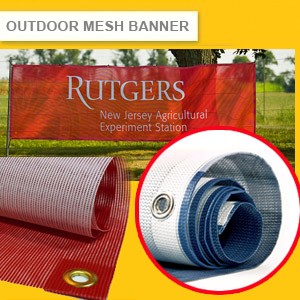
Mesh works differently. It’s covered in thousands of tiny holes that let air pass straight through the material instead of slamming into it. Less resistance means less strain on the eyelets, the ropes, and whatever it’s tied to.
That’s why construction sites, coastal shopfronts, and event fences almost always use mesh instead of solid vinyl.
Not All Mesh Is the Same
This is where a lot of people get it wrong. They think “mesh” is one product. It’s not.
Mesh banners come in different blockout percentages, and that number tells you how much wind resistance you’re dealing with.
Premium mesh (around 80% blockout, 20% airflow) gives you sharp, vibrant print quality. It looks great. But it’s not built for serious wind, so keep it for sheltered spots like a shopfront under an awning.
Standard mesh (around 65% blockout, 35% airflow) sits in the middle. Good for most everyday outdoor spots that get some wind but nothing extreme.
Open weave mesh (around 50% blockout, 50% airflow) is your go-to for exposed, coastal, or storm-prone areas. It sacrifices a bit of print sharpness, but it lets half the wind straight through, so your banner and your fence stay standing.
If your site is right on the coast, near open paddocks, or up on a hill with nothing blocking the wind, go with open weave. It’s not the fanciest option, but it’s the one that survives.
What Australian Standards Say About This
If you’re putting mesh banners on temporary fencing, this part actually matters.
Temporary fencing in Australia needs to meet AS 4687, which sets a minimum wind speed the fence must handle, 54 km/hr. That’s not a big storm. That’s a normal windy afternoon in a lot of Australian towns.
Add a banner to that fence, even a mesh one, and you’re changing how much wind load it can take. A dense mesh with only 10% airflow still catches most of the wind pushing against it. So the mesh you pick genuinely affects whether your fence stays upright.
If you’re not sure what your site needs, it’s worth asking before you order, not after your banner ends up in the neighbour’s yard.
Getting the Installation Right
Even the best outdoor mesh banner will fail if it’s put up badly. A few things make a real difference.
Use eyelets at every point, not every second one. This spreads the wind load evenly instead of putting all the pressure on a handful of spots.
Tension it properly. A loose banner flaps, and flapping is what tears mesh apart over time. Pull it tight when you install it.
Check your fixings. Cable ties or bungee hooks rated for outdoor use, not the cheap ones from the hardware store bargain bin. Salt air and UV break down cheap plastic fast.
Reinforced hems and rust-free eyelets matter more than people think. They’re the difference between a banner that lasts one season and one that lasts three or four.
Where This Actually Gets Used
Construction sites use mesh banners on hoarding and scaffolding because it’s cheaper than solid hoarding and handles wind far better.
Real estate agents use it for display boards on exposed blocks of land.
Retailers along the coast use it for shopfront signage where a normal banner would be flapping within a week.
Event organisers use it on temporary fencing at festivals and outdoor concerts, where thousands of people and unpredictable weather both show up at once.
If your business fits any of these, mesh is probably the better call over standard vinyl.
Common Mistakes People Make
Picking premium mesh for an exposed site. It looks better in the mock-up, but it won’t survive real wind. Save premium mesh for sheltered spots only.
Skipping eyelets to save a bit of material. This is the fastest way to lose a banner in the first storm.
Not tensioning the banner properly. A loose banner works itself loose even faster.
Assuming all mesh is UV-stabilised. Cheap mesh fades and turns brittle within a year in Australian sun. Ask what you’re actually getting.
Ignoring the fence itself. Even the best mesh banner can’t save a fence that wasn’t rated for wind in the first place.
FAQs
How long do outdoor mesh banners last in Australian conditions?
A good quality, UV-stabilised mesh banner usually lasts 2 to 5 years outdoors. Coastal sites with salt air and constant wind sit at the lower end of that range.
Can I reuse a mesh banner on a different site?
Yes. Mesh banners with reinforced edges and rust-free eyelets can be taken down, rolled up, and reused on a new job or site layout.
What’s the difference between mesh and shade cloth?
Shade cloth is made for sun protection, not branding. Banner mesh is a printed PVC material built for outdoor advertising, with a proper print surface and known airflow ratings.
Do I need a special mesh for cyclone season?
For storm-prone or cyclone-affected areas, open weave mesh with maximum airflow is the safest bet. It’s also worth adding wind flaps, small cuts in the material, to release extra gusts.
Is mesh banner printing more expensive than vinyl?
Not really. Pricing is usually similar. The real cost difference shows up later, when a vinyl banner tears in month two and you’re paying to replace it.
What You Should Do Next
If your site gets hit by wind more often than not, don’t wait until you’ve lost a banner to figure this out.
At Banner Online, we print outdoor mesh banners built for exactly this kind of Australian weather, whether that’s a coastal shopfront, a construction hoarding, or an exposed event site. Have a look at our range and pick the mesh that actually matches your location, not just the one that looks best on screen.
Check out our outdoor mesh banners here:
https://flagbanner.com.au/all-products/outdoor-vinyl-banner-mesh-banner.html